


A: Attributes of Leaders
Defining What and How Leaders Inspire Results
Effective leadership is defined by actions and behaviors rather than solely by personality traits.
This workshop uses the strong foundations of leadership established in the first two workshops and builds on this in a highly practical manner. Consider great coaches you admire, are inspired by, and have found to be effective. The behaviors of those coaches as leaders, which contributed to their effectiveness, may show what attributes you may want to model in yourself to increase your effectiveness. Today, more than ever, we recognize leadership is behavioral in nature and so are skills we can develop. We look at what a leader does and the actions they take. We can even measure a leader’s effectiveness as much by who they are and just perhaps more by what they do. This workshop is dedicated to developing your personal attributes of an effective leader in the coaching role you are in.
Learning outcomes
- Build leadership skills through the understanding and application of personal and performance character attributes.
- Utilize 7 different methods of developing these leadership character attributes in coaching.
- Outline and commit to a 4-week plan for implementing key personalized leadership strategies, reflection, and refinement.
- Uncover skills to lead and enhance strength and conditioning and personal training program administration across your staff.
Download your Accompanying Workshop 3: Attributes of Others Workbook
Zoom Link - Attend your 90-minute Live Workshop
Thursday, June 4 at 5:00pm – 6:30pm Eastern
Meeting ID: 839 0476 0366
Passcode: 578987
Watch 90-minute Live Workshop #3
A: Attributes of Leaders
A: Attributes of leaders
Follow up to Workshop
After attending the live workshop, let's recap key themes and continue to build your leadership capability.
Early in this program, you completed an activity on a leader you found to be effective. Take a look at what you wrote and identify the behaviors of that leader which contributed to their effectiveness. What we are referring to when we talk about attributes, are the unique characteristics of that leader.
Today more than ever we recognize leadership is behavioral in nature. We look at what a leader does and the actions they take. We even judge a leaders effectiveness not so much by who they are, but more by what they do.
Of course, who they are impacts what they do, but it can be hard to ‘see’ the ‘who’ component of a leader. It is always much easier to “see and hear” how someone behaves. This is another reason why we use DISC. It helps to develop understanding of others and is a measure of observable behaviors.
Attributes are behaviors such as:
- Decisiveness
- Directness
- Openness to others
- Clear communication
- Listening
- Enthusiastic or quiet communication
- Able to give and receive feedback
- Sets high standards and is accountable
- Holds team members accountable
The list of behaviors goes on.
“Leadership – What I see, What I say, What I do”
Bo Hanson
ACTIVITY: LEADERSHIP ATTRIBUTE REFLECTION
Reflect on the behaviors you most value in other leaders and the attributes you would like to further develop in yourself. Complete this activity on page 3 of your ‘Attributes of Leaders’ workbook.
- What behavioral attributes do you most value in other leaders?
- What other attributes do you want to develop?
Building leadership Character through behavior
Being a leader is a 24/7 role. Leaders are always in the spotlight, with their character revealed through their behaviors and how others perceive them. While no leader is perfect, their actions are constantly observed, especially in today’s hyper-connected world. History offers both poor examples to learn from and inspiring ones to emulate.
This section of your workbook focuses on understanding the behaviors that shape your Leadership Character. Drawing from Jim Loehr’s The Only Way to Win, we explore two types of character:
- Performance Character: Skills and behaviors that drive results.
- Personal Character: The deeper qualities that define you as a leader and set you apart.
Through descriptions and reflective activities, you will identify and develop both aspects of your character. This process will guide your growth as a leader and help you become someone your team and college are proud to follow.
Personal & Performance Characteristics
While having strong Performance characteristics can drive results, neglecting Personal characteristics can lead to unsustainable success that may harm relationships and the broader environment. Research emphasizes that Personal characteristics form the foundation for developing sustainable performance. Building strong Personal traits supports and enhances Performance traits, leading to well-rounded leadership.
Behavior as a Path to Growth
Leadership character is expressed through behavior, which is adaptable and measurable. By focusing on your actions, you can develop your character and improve both personal and team outcomes. Tools like Athlete Assessments’ DISC Profiles help identify strengths and weaknesses. Keep in mind how our greatest strengths can also be our greatest weaknesses when overused.
To guide this development, exercises like the Character Scorecard encourage leaders to reflect on their behaviors and ensure their strengths are used to enhance both personal and team success.
Character Scorecard
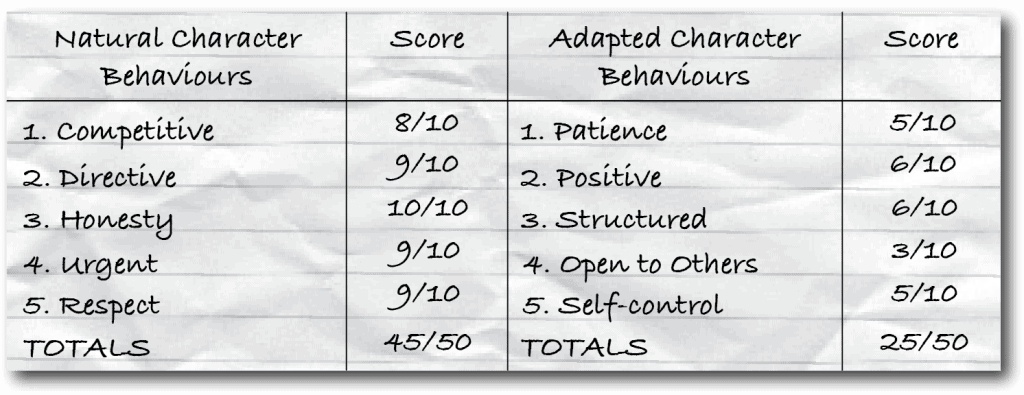
The Character Scorecard helps leaders identify their strengths (Natural Character Behaviors) and limitations (Adapted Character Behaviors) based on their DISC Profile. Leaders focus on five strengths and five areas for development, using their DISC Report to pinpoint these behaviors.
Each week, leaders rate their performance in these areas on a scale of 1 to 10. A low score indicates an area for improvement, and the goal is to develop your ‘character muscle’—the ability to consistently apply effective behaviors, especially under pressure. Like physical muscles, your character traits need regular practice and attention to grow stronger.
The Character Scorecard is aligned with the Situation x Behavior = Results model, where each situation is an opportunity to apply the right behavior. By regularly reviewing your scorecard, you evaluate how your behavior choices are impacting your results. Leaders should balance Performance Characteristics (e.g., confidence, focus, mental toughness) with Personal Characteristics (e.g., integrity, respect, compassion). While Performance traits are crucial for results, Personal traits provide the foundation for sustainable success. Regular reflection and self-assessment help leaders strengthen both areas, leading to more effective leadership.
Below is an example scorecard from Bo’s leadership role at the 2004 Olympics.
Refer to pages 8-11 of your 'Attributes of Leaders' workbook to complete your own scorecard over the next four weeks.
developing attributes of leaders
Before we look at development strategies, we first need to understand how to develop our ‘character muscle’ or leadership effectiveness.
The first choice is to take ownership and be accountable for structuring a plan to address these Character Limitations yourself. This obviously is a mark of a true leader who recognizes they need to improve and then takes action to make it happen, reviewing their progress and asking for feedback from others to ensure they are making progress.
The second choice is not as desired, but often seen enacted. This choice is about referring to others to ‘push’ you to develop. Here others set a plan for you, tell you what to do and closely monitor your completion of various tasks to help you improve.
For the purpose of this activity, choose the first option and take ownership of what you are trying to improve. Still ask your peers, managers, and mentors to guide you and provide advice, however you are rewarded with massive growth by taking this option.
Here are 7 methods to use to help you address your Leadership Character limitations and form a plan.
Use this method as part of your Character Scorecard each week.
THE CIRCLE OF SAFETY
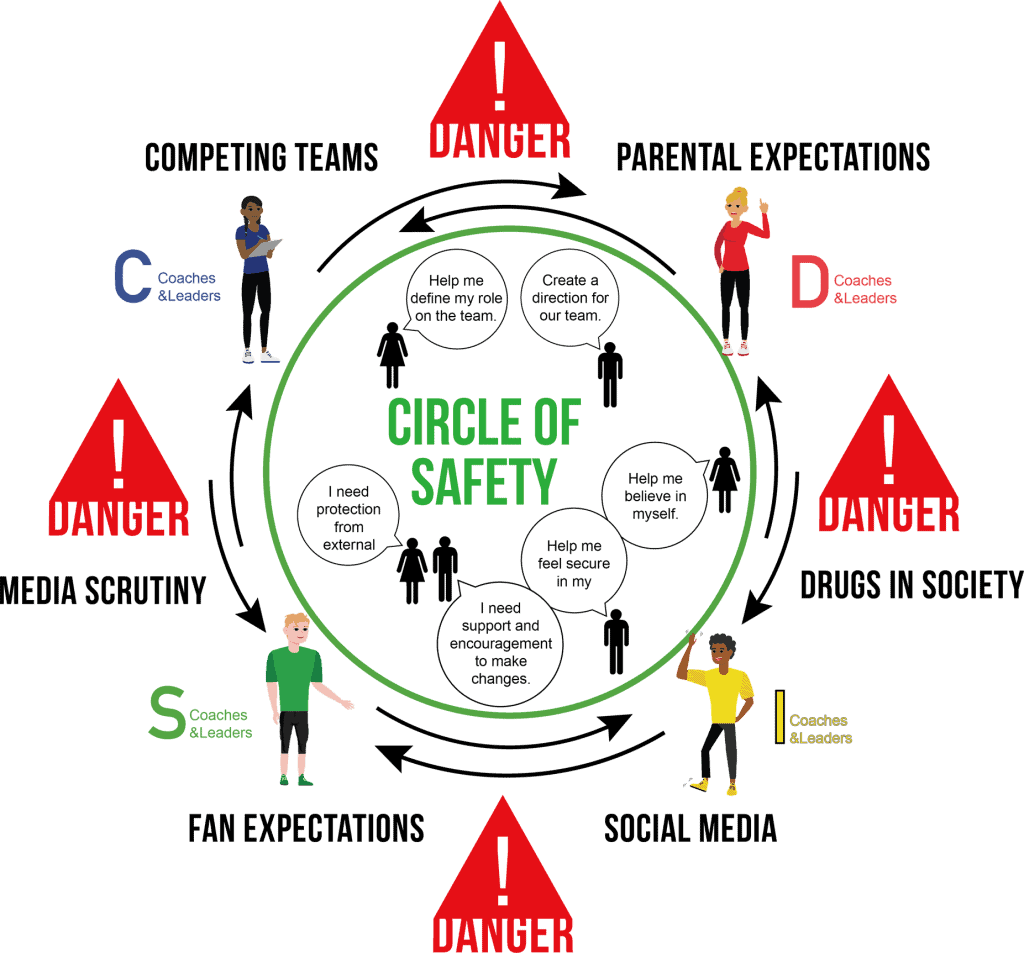
As a leader, understanding psychological models like the Circle of Safety is essential. Rooted in Maslow’s Hierarchy of Needs, this model shows that after meeting basic needs like food and shelter, our next priority is safety. Without feeling safe, people focus on survival rather than performance. A leader’s role is to create a safe environment where team members can thrive without fear of physical, psychological, or emotional threats.
Within the Circle of Safety, risks like harsh criticism, bullying, or performance anxiety can arise. It’s important to recognize and address these dangers, whether by resolving conflicts, teaching new skills, or fostering a positive culture.
Using DISC helps leaders understand individual behaviors, ensuring a supportive environment where team members can perform at their best. By promoting safety and self-awareness, leaders can empower their teams to thrive and reach their full potential.
ACTIVITY: Circle of Safety
What constitutes a threat to an individual’s safety that you as a leader and S&C Coach can protect them from? Write your answer on page 13 in your ‘Attributes of Leaders’ workbook.
optional bonus activity: 360⁰ Feedback
Using Your CoachDISC Profile to collect feedback from others.
Athlete Assessments’ DISC Profiles all have the capability to convert into a 360⁰ feedback tool. While completely optional and at your discretion, it enables you to invite those around you (we call them ‘Observers’) to share their insights into how they perceive your behavior within your coaching environment.
Observers can include colleagues, management, peers, support staff, family members, athletes, and others who know you well. We recommend only asking people who have the ability to provide you with useful feedback and who have personal experience of working with you or observing you in your working environment.
As you have already completed your CoachDISC Profile, you can now log back into your personal account to initiate this exercise. Please note, if you do invite observers, you need to download your CoachDISC Profile Report again after they have completed the observer feedback process to incorporate their responses into your report and also print off the ‘observer graphs’ within your personal account. If you need assistance with this, please contact the person who organized your CoachDISC Profile or contact Athlete Assessments.
What did you learn?
- If you elected to utilise the Observer Feedback process, What did you learn from your 360⁰ Feedback?