Athlete Assessments & the National Strength and Conditioning Association
NSCA Coaching Leadership Course
Preparing for your First Workshop
What To Do With Your CoachDISC Report
Now that you have completed the survey and received your individual CoachDISC Profile Report via email, we encourage you to print or save the report somewhere you can access at a later stage.
It's time to maximize the use of your report by completing the necessary tasks ahead of applying it to your professional development.
Step 1
Read through your CoachDISC Report, giving particular attention to Part I.
Step 2
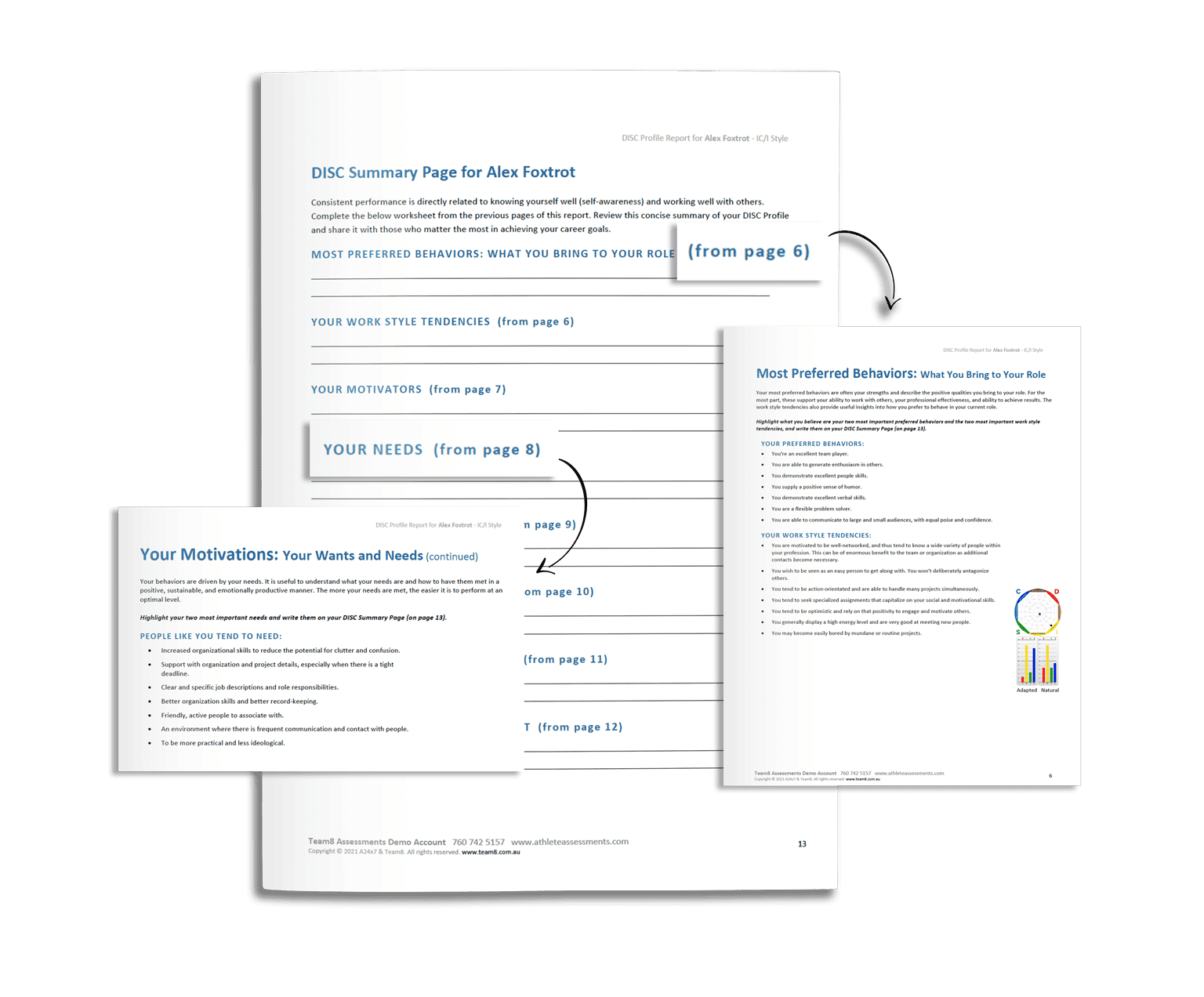
Complete your Summary Page
Consistent performance is directly related to knowing yourself well (self-awareness), leading, and working well with others. Here’s the first thing you can do to start to get the most value from your CoachDISC Report.
As you read over Part I of your report, fill in the Summary Page on page 13 of your CoachDISC Report with the key things you identify from each section.
Keep this summary somewhere you can easily access, so you can revisit your profile and share it with those who matter most in achieving your goals. This will also ensure you get the most out of the first workshop with Bo Hanson.
Leadership: The Foundations
After reading the content and watching the videos below, download the Leadership Foundations Preparation workbook, review the information, and complete the activities within to prepare for your first program workshop.
Download your Accompanying Leadership Foundations Workbook
Leading in today’s environment is a dynamic challenge. It demands skills that must be learnt and developed over time. Organizations and teams need people who are capable of making a positive contribution to their programs and beyond. This program is our way of helping you become a leader who acts in the best interests of their people and with the greater good for their team in mind.
Leadership can be learnt.
Leadership is a complex set of behaviors that develop over time with attention and effort. One is never “born” a great leader. Even those who appear to be natural leaders, have learnt the concept through their environment and exposure to others who have either consciously or inadvertently taught them how to lead.
Or sometimes, how not to lead. Most leaders are highly effective at certain aspects of leadership and need development in other aspects. This is normal. Just as it is normal for society to have a stereotypical view as to what leadership is. This program aims to develop the whole leadership picture and elaborate on the less obvious leadership behaviors and styles.
You can be certain your leadership competency is totally hinged on the effort you put in to develop yourself and your skills. Becoming the leader you want to be is 100% within your control.
My experiences as an athlete, and the leadership lessons I learnt from my sport, have helped me be the person I am today.
– Bo Hanson
Introducing the L.E.A.D. Model for Leaders in Sport
As we progress through this program together, we will be using the L.E.A.D. Model to describe the vital elements of leaders, work through understanding your CoachDISC Profile, and apply this knowledge to leading yourself and others effectively.
The L.E.A.D. Model is a simple yet powerful framework for effective leadership. It focuses on four key areas:
L: Lead Yourself
The foundation of leadership is self-mastery. Develop strong self-awareness to know how to be consistently at your best.
E: Engage Others
Building relationships with diverse people is fundamental to leadership effectiveness.
A: Attributes of Leaders
‘Leadership is, as leadership does.’ Focus on the behaviors of leaders – what they do and how they act.
D: Direction & Action
Set your vision and goals. Most importantly, take ownership, drive accountability, and stay on track.
Watch the video below for an introduction to the L.E.A.D Model.
WHAT IS LEADERSHIP?
Leadership can be defined and explained in countless ways, with models and books attempting to capture its complexity. But let’s keep it practical and straightforward. While simple doesn’t mean easy, leadership is rarely easy, it can be broken down into its core essence: leadership is about attracting followers.
Followers are drawn to leaders through various behaviors and leadership styles. Developing these behaviors is key to becoming an effective leader.
Leaders can attract followers by:
1. Being an expert who is well structured and organized so followers heed your advice.
2. Being a visionary with a clear goal which others want to be part of.
3. Being energetic and enthusiastic so others want to be around you.
4. Being able to form close relationships with trust so others feel safe in your company and the environment you create.
Leadership involves using different styles to attract and inspire followers. These styles are shaped by the leader’s natural preferences, the needs of their followers, and the specific situations they encounter. While most leaders have a style that feels most natural to them, effective leadership requires learning to adapt to what the moment calls for.
In this program, we use the L.E.A.D. Model to help you explore your preferred leadership style and develop the ability to adapt it. This model emphasizes the importance of understanding yourself (Self-Mastery) as the foundation for leading others effectively. Through your CoachDISC Profile, you’ll gain insights into your natural leadership tendencies and how to use them to meet the needs of your athletes, colleagues, and organization.
Watch the video below to understand more about how leadership is defined across history.
Complete Workbook Activities
Before attending the first live workshop, complete pages 4-9 in the Leadership Foundations workbook to explore what leadership means to you, the types of leaders who inspire you, and the kind of leader you want to be.
You're Ready to Attend the First Workshop - Join Here